
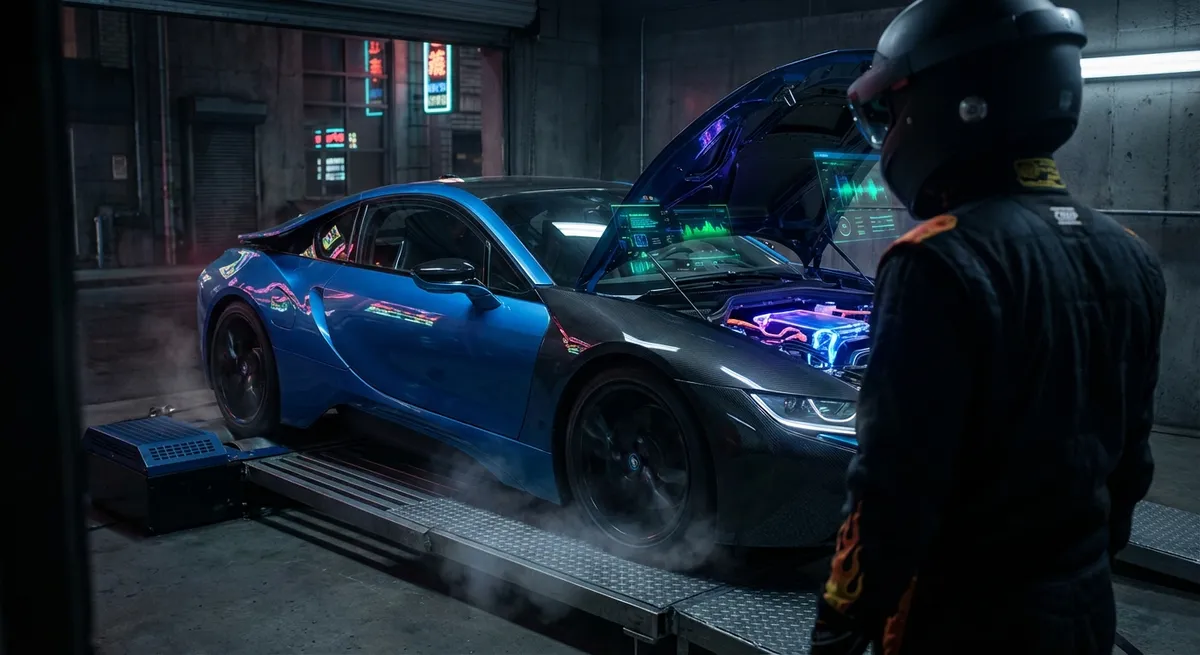
Modern performance cars aren’t just faster—they’re smarter, tighter, and way more tunable than anything we grew up with. Under the sheet metal, auto tech has quietly rewritten the rules for speed, safety, and longevity. If you understand what’s happening behind the scenes, you can unlock real performance, avoid expensive mistakes, and keep your car feeling fierce well past the warranty period.
This is your guided tour through the tech that actually matters, and how to use it to your advantage.
The ECU: Your Car’s Brain and the Gateway to Power
Every modern car performance story starts with the ECU (Engine Control Unit). This little metal box is the command center that controls fuel injection, ignition timing, boost pressure (on turbo cars), throttle response, and even how aggressively the transmission shifts. When people say “the car feels lazy” or “this tune woke it up,” they’re really talking about ECU strategy.
From the factory, ECUs are calibrated with huge safety margins: emissions targets, fuel quality variations, climate extremes, and driver abuse all have to be covered. That’s why a simple software change on a turbocharged engine can unlock serious power—manufacturers often leave headroom on the table. But nothing is free: push timing or boost too far on poor-quality fuel and that same ECU will start pulling timing or dumping extra fuel to protect the engine, killing performance and sometimes still not saving the hardware.
For enthusiasts, the key is to treat tuning as precision engineering, not a magic button. Quality tuners log data (intake temps, knock activity, fuel trims, lambda) rather than just chasing peak dyno numbers. Modern ECUs are incredibly capable, but they assume you’ll keep the rest of the system healthy: clean injectors, proper cooling, and fuel that matches the tune’s octane requirements. When the hardware and software are in sync, the car feels like it’s reading your mind instead of just responding to your right foot.
Key Point #1 – ECU Health & Tuning Discipline:
Keep your software up to date, be honest about your fuel quality, and if you’re tuned, log data regularly. Smart tuning is sustainable tuning—chasing aggressive maps with no data is the fastest way to turn tech into a repair bill.
Turbocharging, Cooling, and the Hidden Battle Against Heat
If you’re driving anything remotely sporty from the last decade, there’s a good chance it’s turbocharged. Turbo tech has become the default answer for blending performance with efficiency, but it’s also turned heat management into the critical battleground for reliability.
A turbo is essentially a heat-powered air pump. It uses exhaust energy to compress intake air, cramming more oxygen into the cylinders for more power. But compressed air gets hot, and hot air is less dense and more prone to detonation—exactly what you don’t want in a high-output engine. Enter intercoolers, charge pipes, and increasingly complex cooling systems with electric water pumps, multiple radiators, and even dedicated coolant loops for turbos and batteries in hybrids.
The performance you feel on a quick backroad blast is mostly determined by how well your car fights heat soak. The first pull might feel great; by the third or fourth, intake air temps climb, the ECU pulls power to protect the engine, and the car feels dulled. That’s not “the car being slow”—it’s the software saving the hardware from abuse.
Key Point #2 – Cooling as a Performance Mod:
Pay attention to coolant condition, intercooler cleanliness, and airflow. Even stock cars benefit from clean radiators, correct coolant mix, and avoiding unnecessary grille blockages. For tuned or tracked cars, upgraded intercoolers and well-designed ducting can deliver more consistent power than a flashy exhaust ever will.
Chassis Electronics: The Silent Heroes of Grip and Stability
Underneath the bodywork, modern chassis electronics are doing absurdly complex math to keep you fast and facing forward. ABS, traction control, stability control, torque vectoring, adaptive dampers, and electronically controlled power steering all feed off a shared network of sensors: wheel speeds, steering angle, yaw rate, throttle position, brake pressure, and more.
Old-school drivers sometimes complain that “electronics kill the fun,” but in reality, well-tuned systems let you use more of the car, more of the time. Torque vectoring by braking or by differential can rotate the car into a corner without you having to rely on clumsy lift-off oversteer. Adaptive dampers can serve up a comfy commute on Monday and tighten body control for canyon carving on Saturday with a single button press.
The catch? These systems assume everything is mechanically healthy. Worn bushings, uneven tire wear, incorrect tire pressures, or a mismatched tire setup can confuse the algorithms and lead to inconsistent behavior. When a modern car suddenly feels “nervous” or “twitchy,” it’s often the electronics doing heroic work to compensate for underlying hardware issues.
Key Point #3 – Chassis Tech Needs a Solid Foundation:
Don’t treat electronic aids as a band-aid. Keep alignment, bushings, and tires in top condition. Think of the electronics as amplifiers: they make a good setup feel fantastic, and a bad setup feel weird, snappy, or inconsistent.
Data-Driven Maintenance: Using Built-In Tech to Protect Performance
The same sensors that help your car go fast and stay safe can also keep it healthy—if you listen to them. Modern vehicles constantly monitor oil temperature, coolant temperature, misfires, fuel trims, knock events, DPF loading (on diesels), and even driving style. That’s why service intervals are often mileage or time or condition-based instead of fixed numbers from the past.
Ignoring warning lights or “service due” messages in a modern car is worse than it used to be, because those warnings are usually backed by actual data, not just a simple odometer countdown. An intermittent misfire might be caught and logged long before you feel it. A failing O2 sensor or MAF sensor can trigger subtle fuel trim changes that rob power and fuel economy without feeling dramatic from the driver’s seat.
Where enthusiasts really win is by combining OEM diagnostics with enthusiast-grade tools. An inexpensive OBD-II Bluetooth adapter and a reputable app can unlock live data: intake air temps, coolant temps, ignition timing, short- and long-term fuel trims, and more. Watching how these values behave over time tells you whether your engine is genuinely happy or just hiding an issue that will surface under hard use.
Key Point #4 – Diagnostics as Performance Insurance:
Use scan tools before there’s a problem, not after. Baseline your car when it’s healthy so you know what “normal” looks like. Catching a marginal coil pack, weak sensor, or clogged injector early keeps performance consistent and prevents cascading failures.
Software Updates, Connectivity, and the New Upgrade Path
The most radical shift in auto tech might be that cars are no longer “finished” when you drive them off the lot. Over-the-air (OTA) updates and connectivity mean manufacturers can rewrite calibration, add features, alter shift logic, tweak steering feel, and even unlock new performance remotely. Tesla popularized this idea, but other brands are rapidly following with their own ecosystems.
For enthusiasts, this cuts both ways. On one hand, you might get sharper throttle response, better energy management, or improved driver-assistance behavior without touching a wrench. On the other, subscription-based features and paywalled performance modes are becoming a thing, and some OEM updates may alter how your tuned or modified car behaves.
The smart play is to treat software updates with the same respect you’d give a hardware change. Know what the update targets, check with your tuner or community if your car is modified, and keep records of what software version you’re running. Connectivity can also work in your favor with apps that log trips, monitor health, and even schedule service proactively, turning your phone into an extension of your tool kit rather than just a media controller.
Key Point #5 – Manage Your Car’s Software Like a Build Sheet:
Track software versions, understand what each update changes, and coordinate with any aftermarket tuning. Modern performance is a living system—hardware and software evolve together, and ignoring one side means leaving capability (or reliability) on the table.
Conclusion
Auto tech has completely reshaped what “performance” means. It’s no longer just displacement and gearing—it’s strategy, temperature control, algorithms, and data. The upside is massive: more power from smaller engines, more grip from smarter chassis, more safety without sacrificing speed, and the ability to diagnose issues before they become disasters.
If you treat your car’s tech as a partner instead of a black box—respecting the ECU, managing heat, supporting the chassis electronics, using data for maintenance, and staying on top of software—you unlock the real potential baked into every modern performance platform. That’s how you keep your car not just running, but attacking every drive like it’s brand new.
Sources
- [U.S. Department of Energy – Engine Control Unit (ECU) Basics](https://afdc.energy.gov/vehicles/how-do-hybrids-work) – Explains how modern powertrain control systems manage engines and hybrids
- [Bosch Mobility – Turbocharging and Engine Boosting Systems](https://www.bosch-mobility.com/en/solutions/powertrain-systems/gasoline-systems/gasoline-turbocharging/) – Technical overview of turbocharger technology and its role in performance and efficiency
- [Continental Automotive – Chassis & Safety Systems](https://www.continental-automotive.com/en/solutions/chassis-safety) – Details on ABS, ESC, and advanced chassis control technologies used in modern vehicles
- [SAE International – Vehicle Diagnostics and OBD-II](https://www.sae.org/standards/content/j1979_201202/) – Technical standard underpinning modern onboard diagnostics and live data access
- [National Highway Traffic Safety Administration (NHTSA) – Cybersecurity & Vehicle Software Updates](https://www.nhtsa.gov/vehicle-cybersecurity) – Discusses connected car software, OTA updates, and safety implications